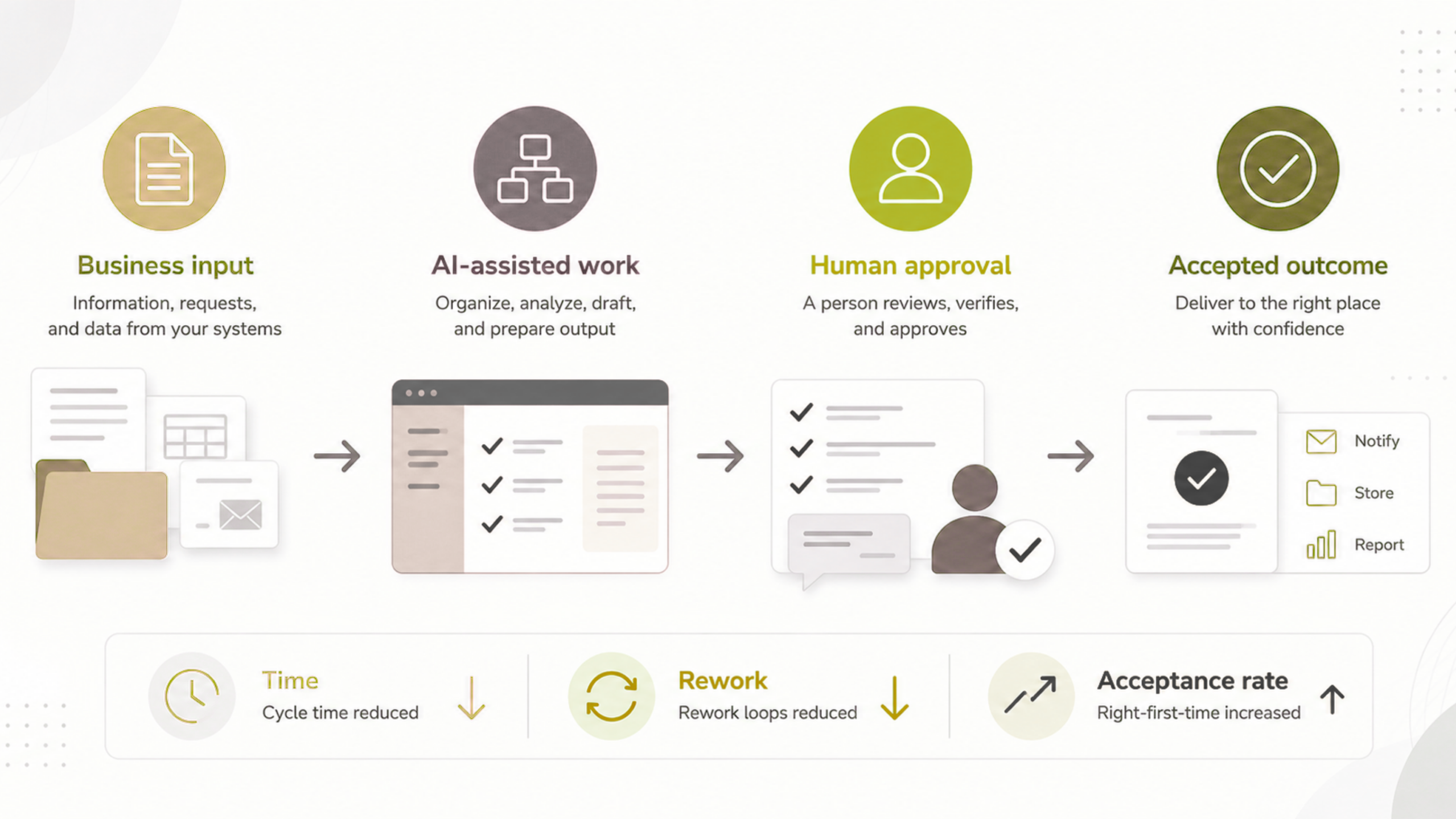
Where Should AI Act; and Where Should a Human Decide?

“Keep a human in the loop” sounds sensible. It is also incomplete.
Which person is responsible? What exactly must they review? At what point do they intervene? And what should happen when the AI meets an exception nobody planned for?
AI agents can search for information, update systems, prepare reports, coordinate tasks and trigger actions across a workflow. Once an agent can act, not just draft, a general promise of human oversight is no longer enough. The business needs a clear decision boundary.
What is an AI decision boundary?
An AI decision boundary sets out what the system may do on its own, what needs approval, when work must be escalated, which information the system may access and who remains accountable for the outcome.
That boundary belongs to the workflow, not to the technology in isolation.
An agent that summarizes an internal meeting does not need the same controls as one that issues refunds, changes orders, makes contractual commitments or handles sensitive employee information. The goal is not maximum automation. It is the right amount of autonomy for the value, risk and maturity of the work.
Why this matters now
Businesses are moving beyond isolated prompts. They are beginning to use agents across connected steps in real workflows.
Microsoft’s 2026 Work Trend Index describes a shift in which agents take on more execution while people direct the work, make judgments and remain responsible for outcomes.
OpenAI’s enterprise guidance makes a similar point, emphasizing workflow design, accountability, governance, evaluation and human oversight when AI moves into production.
This makes AI adoption an operating decision, not merely a software purchase.
Before granting more autonomy, a business has to understand the workflow, its rules, its exceptions and the consequences of a wrong action. If the process is unclear, automation can make confusion move faster.
Businesses still deciding which workflow deserves investment can begin with “Before You Invest in an AI Agent, Find the Workflow That Pays”.
Five levels of AI autonomy
It helps to treat autonomy as a ladder. A workflow should move upward only when its controls and evidence justify the change.
Level 1: Observe and organize
The AI collects, classifies, summarizes or structures information. It does not recommend or execute a business action.
It might categorize support requests, summarize meeting notes, extract fields from documents or organize research into a standard format. A person reviews the result and decides what happens next.
This is a sensible starting point when the organization is still learning about its data, the process or the quality standard.
Level 2: Recommend
The AI reviews the available information and proposes an action.
It could suggest how to route a customer request, flag an invoice for investigation, recommend which follow-up deserves priority or draft a response based on an approved policy.
The person still makes the decision. AI shortens the preparation needed to reach it.
Level 3: Execute after approval
The AI prepares an action, but an authorized person must approve it before anything happens.
Examples include preparing a customer refund, drafting a supplier order, proposing a project-schedule change, creating a personalized customer message or preparing CRM follow-up actions.
This level makes sense when the work is repeatable but the action still carries financial, contractual, operational or reputational consequences.
The approval must be real. Someone clicking “approve” without enough context is not exercising meaningful oversight.
Level 4: Execute within defined limits
The AI acts independently when a case falls inside approved rules. Anything outside those rules is escalated.
It might answer routine questions from an approved knowledge base, schedule meetings within authorized calendars, route standard requests, update low-risk records after validation checks or send reminders using approved language.
“Within defined limits” is doing a lot of work here.
The business must specify thresholds, permissions, prohibited actions, escalation conditions and monitoring requirements. Without them, limited autonomy can quietly turn into uncontrolled autonomy.
Level 5: Operate autonomously within a bounded workflow
At this level, the AI manages most of a clearly defined workflow. People monitor performance, investigate exceptions and remain accountable for the system.
This level belongs only in workflows where the intended outcome is clear, actions are observable, errors can be detected quickly, most actions are reversible, permissions are controlled, performance is evaluated and escalation paths have been tested.
Level 5 does not remove people. It changes their role. Instead of approving every action, they govern the workflow, review unusual cases and improve the system.
Five tests for setting the boundary
Before choosing an autonomy level, examine the workflow through five tests.
1. Consequence
What happens if the AI is wrong?
An inaccurate internal summary may create inconvenience. An error involving a payment, employment decision, contractual commitment, production instruction or sensitive customer case can cause real harm.
The greater the consequence, the closer accountable human authority should sit to the action.
2. Reversibility
Can the action be undone quickly and completely?
Drafting, classifying and recommending are usually reversible. Sending money, deleting records, publishing confidential information or making a binding commitment may not be.
Hard-to-reverse actions generally need stronger approval.
3. Rule clarity
Can the organization explain the correct action through clear policies, thresholds, data and exceptions?
If experienced employees regularly disagree about what should happen, the workflow may not be ready for high autonomy. AI cannot repair missing business rules. The organization has to clarify the decision first.
4. Visibility
Will the organization know when the AI makes a mistake?
Automation is safer when inputs, actions, outputs and exceptions can be monitored. If an error remains invisible until a customer complains or a financial discrepancy appears, the proposed autonomy level is probably too high.
Monitoring belongs in the design from the start.
5. Sensitivity
Does the work involve confidential information, personal data, security permissions, legal obligations or vulnerable individuals?
Sensitive workflows need tighter access, documentation, review and accountability. An output may be technically correct and still be inappropriate if the system should not have accessed the information or taken the action.
An illustrative example: customer requests
Consider a business receiving customer requests through email, web forms and messaging channels.
At Level 1, AI classifies each request and summarizes the issue. At Level 2, it recommends a response and the appropriate department. At Level 3, it drafts and queues the response for approval.
At Level 4, it answers routine questions from approved information while escalating refunds, complaints, cancellations and unusual cases. At Level 5, it could coordinate a bounded service workflow across connected systems while managers monitor performance and review exceptions.
The right level depends on the business’s policies, systems, data quality, service commitments and risk tolerance.
The framework can also be applied to finance, sales, procurement, education operations, manufacturing and internal administration. These are illustrations, not claims about a specific LeLaboDigital client implementation.
Define escalation before increasing autonomy
The normal case is rarely the hardest part of a workflow. Problems appear when information is missing, instructions conflict or a case falls outside the expected rules.
Before an agent receives greater authority, define the conditions that stop the workflow, actions it may never take, thresholds that need approval, the person who receives an escalation, the context that person needs and how the eventual decision will be recorded.
The exceptions should also feed back into the system. They show where rules are incomplete, where evaluations need improvement and where the autonomy boundary may be too wide.
Escalation is part of the design. It should not be invented after an incident.
Start with one bounded workflow
A business does not need a complete AI operating model before taking a useful first step.
Choose a recurring workflow with a clear owner, defined inputs and outputs, an observable baseline, enough volume or value to justify improvement and manageable consequences if the first version is imperfect.
Document how the work happens today. Identify its decisions and exceptions. Choose an initial autonomy level, then decide what evidence would justify moving higher.
A controlled test can measure accuracy, time saved, exception rates, adoption and business impact.
For a structured testing approach, see “How to Test AI in Your Business—and Decide What to Do Next”.
The aim is not to remove people from the workflow. It is to automate where speed and consistency create value while keeping human judgment close to decisions where context, accountability and consequence matter most.
Find the Right AI Opportunities for Your Business
Identify one valuable workflow, determine the appropriate level of AI autonomy and clarify the controls needed before investing in implementation.
Open the AI opportunity conversation
AUTHOR
Business Development Manager at LeLaboDigital, focused on connecting client challenges with practical digital solutions across web, automation, AI, SEO, and growth strategy.