
Before You Invest in an AI Agent, Find the Workflow That Pays
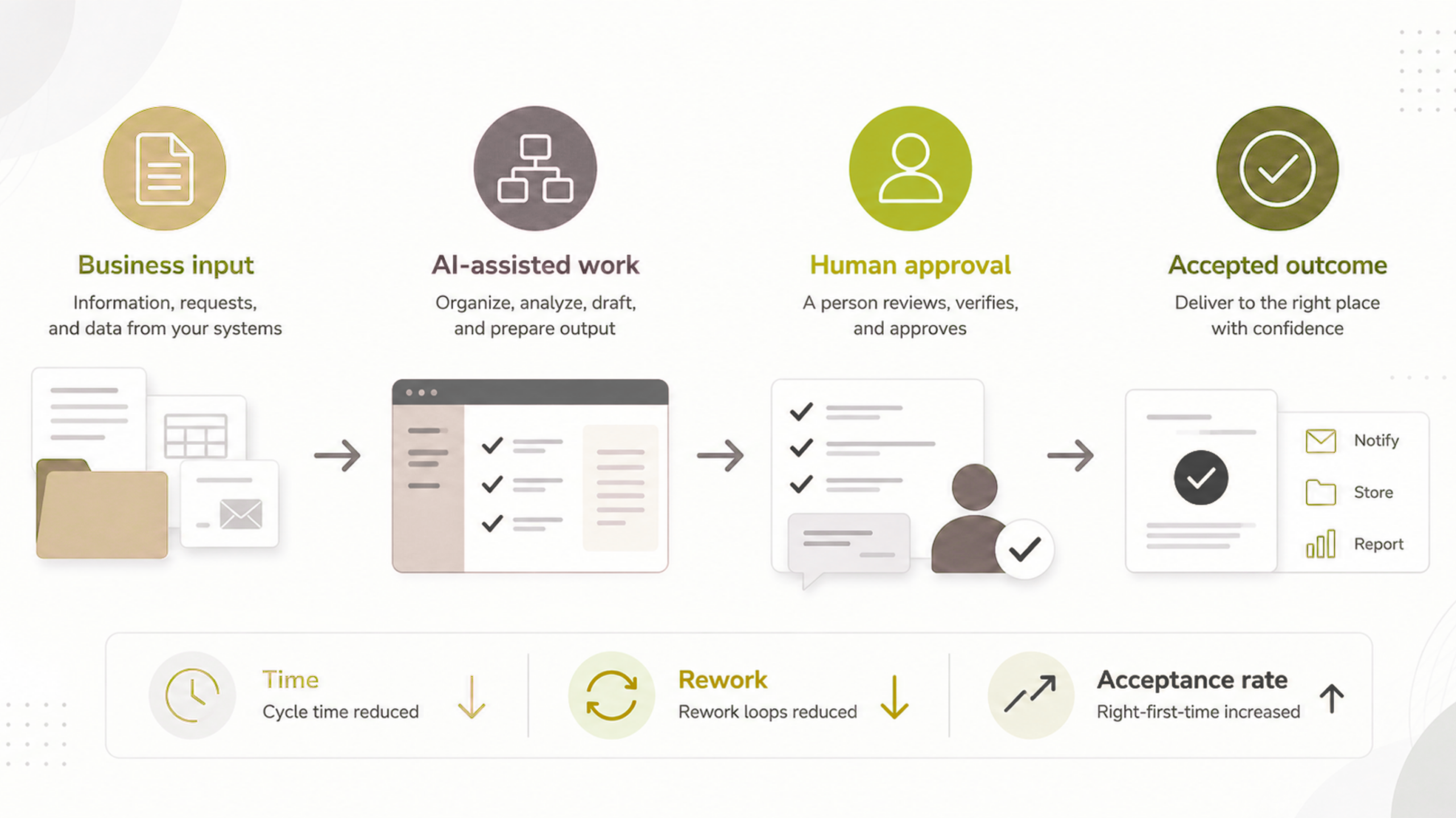
AI workflow automation should begin with a recurring process that has a measurable cost, a clear quality standard, and an outcome worth improving—not with a platform comparison.
Buying an AI agent before defining the workflow is backwards.
Businesses often begin with questions such as:
- Which platform should we use?
- What systems should we connect?
- How much can the agent do independently?
These questions matter, but they come later.
The better starting point is:
Which recurring workflow costs enough in time, delays, errors, or rework to justify improving it?
AI workflow automation means using AI within a defined, recurring process to improve a measurable outcome while keeping ownership, controls, and human approval clear.
A strong candidate has consistent inputs and outputs, a visible current cost, a testable quality standard, and enough repetition or business value to justify the investment.
A capable AI agent is not automatically a valuable investment. A demonstration may prove that the technology works. It cannot prove that it improves your operation.
The workflow—not the tool—is the investment
The business conversation around AI is moving from usage to outcomes.
OpenAI’s July 2026 guidance for business leaders recommends looking beyond token prices and tool usage. For priority workflows, it suggests evaluating the total cost of reaching an accepted outcome, including attempts, completion rates, latency, tool usage, and human review.
The World Economic Forum’s review of AI deployment describes a similar shift. Moving beyond experiments requires more than capable models: organizations also need reliable data, governance, operational readiness, and a measurable business case.
The implication is practical:
Do not select an agent and then search for work to give it. Start with work that already deserves attention.
In the business-development and delivery conversations I handle at LeLaboDigital, the strongest automation opportunities rarely begin with a request for “an agent strategy” in the abstract.
They begin with a specific operational problem:
- Information arrives incomplete.
- Approvals take too long.
- The same data is entered more than once.
- Staff repeatedly chase missing inputs.
- Work is returned because it does not meet the required standard.
- Important decisions are delayed by fragmented handoffs.
Those are workflow problems. AI may help solve them, but only after the workflow is understood.
What makes a workflow worth examining?
The best first automation opportunity is rarely the most ambitious process in the organization.
It is usually a bounded, recurring workflow with:
- Enough volume or value to make improvement worthwhile
- Repeated manual steps
- Clear inputs and expected outputs
- Visible delays, errors, or rework
- An identifiable process owner
- A quality standard that can be tested
- A defined point where human approval remains necessary
A process that changes constantly, depends on undocumented judgment, or has no consistent definition of “done” may need to be clarified before it is automated.
Otherwise, AI can make a confused process move faster without making it better.
A practical example in Education
Consider a school processing student applications.
“Automate admissions” is too broad. It includes sensitive information, policy decisions, and judgments that require institutional accountability.
A more practical first opportunity could be the administrative work around each application:
- Check whether the required documents were submitted.
- Flag missing or inconsistent information.
- Prepare a follow-up message.
- Update the application status.
- Pass the completed file to the authorized reviewer.
The final admission decision remains with the school.
The supporting workflow, however, can be defined and measured. The school could establish a baseline using:
- Staff time per application
- Processing time
- Incomplete-file rates
- Follow-up volume
- Percentage of prepared files accepted without correction
This reflects a broader issue discussed in our article on operational readiness for AI in Education: institutions can adopt new AI tools while their underlying processes remain fragmented.
Those operational measures can support a business case. Simply having an AI agent cannot.
The same principle in Manufacturing
Now consider a manufacturer moving confirmed sales orders into production planning.
Product specifications may be checked by one person, inventory by another, and delivery requirements by a third. Missing information, unclear approvals, or manual re-entry can delay the handoff to production.
The visible problem may appear to be production speed. The actual bottleneck may sit between sales, inventory, and planning.
A focused automation pilot could help:
- Assemble the required order information
- Check whether mandatory fields are complete
- Flag conflicting specifications
- Identify missing approvals
- Prepare a production-ready order for managerial review
The agent would not need to control the factory or change the production schedule independently.
Its first role would be narrower: make the handoff more complete, consistent, and easier to approve.
Possible measures include:
- Time from confirmed order to production-ready file
- Number of manual data-entry steps
- Percentage of orders returned for missing information
- Time spent resolving specification conflicts
- Percentage of prepared orders accepted without correction
Again, the workflow is the unit of investment—not the AI platform.
What applied AI looks like when the workflow is defined
Once the workflow is clearly defined, AI should be given a bounded operational role within it. It may organize inputs, identify missing information, classify requests, compare data against defined rules, prepare drafts, or assemble a case for human review. Its value does not come from being called an “AI agent,” but from producing work that meets an agreed standard and helps the next responsible person act faster and with fewer avoidable corrections.
The same principle applies to accounting and back-office workflow automation, where the real friction often sits around intake, approvals, exceptions, and follow-up—not within one isolated task.
Four mistakes that weaken the business case
1. Choosing a task simply because it consumes time
A time-consuming task is not automatically a strong automation candidate.
If it depends heavily on changing rules, informal knowledge, or unclear ownership, the first step may be process design rather than technology.
2. Treating automation as the removal of people
In many useful workflows, AI prepares, classifies, compares, drafts, or recommends. A person remains responsible for approvals, exceptions, and sensitive decisions.
The objective is not maximum autonomy. It is a better division of work between people and technology.
3. Comparing models by price alone
A lower-cost model may need more retries, correction, or supervision. A more capable model may cost more per interaction while producing acceptable work with less rework.
The relevant measure is the total cost of reaching the required standard—not the cost of one AI request.
4. Mistaking a good demonstration for production readiness
Demonstrations usually rely on clean examples. Real operations contain missing information, permission restrictions, conflicting instructions, and unusual cases.
A credible pilot must test representative work, including the cases most likely to fail.
The LLD AI Workflow Readiness Checklist
Before investing in an AI agent or automation pilot, decision-makers should be able to answer five questions.
1. What exact workflow are we improving?
Define where it starts, where it ends, who owns it, and what triggers it.
2. What does the workflow cost today?
Consider staff time, delays, rework, supervision, missed opportunities, and operational risk.
3. What counts as an accepted outcome?
Set the quality standard before testing the technology. “The agent completed the task” is not enough if the output still requires extensive correction.
4. Which decisions require human approval?
Separate preparation, classification, and recommendations from decisions that require accountable human judgment.
5. What result would justify further investment?
Decide what the pilot must improve—such as cycle time, acceptance rate, processing capacity, or avoidable effort—to earn the next stage of funding.
If these questions cannot be answered, choosing an agent is premature.
Start with one bounded opportunity
A responsible first pilot does not need to transform an entire department.
It needs to test whether one recurring workflow can be completed faster, more consistently, or with less avoidable effort—without introducing unacceptable operational, security, or governance risks.
The sequence is straightforward:
- Document the current workflow.
- Establish its baseline.
- Define the quality standard.
- Set permissions and human approval points.
- Identify stopping and escalation conditions.
- Test representative cases.
- Compare accepted results with the original baseline.
If the pilot creates meaningful value, the organization has evidence for scaling.
If it does not, the organization has learned that before making a larger investment.
Both outcomes are more useful than buying an AI agent without defining what success means.
Identify Your Best Automation Opportunity
We’ll help you assess one high-value workflow, establish its baseline, and determine whether it is ready for a focused automation pilot.
AUTHOR
Business Development Manager at LeLaboDigital, focused on connecting client challenges with practical digital solutions across web, automation, AI, SEO, and growth strategy.