
Accounting AI Is Moving Beyond Data Entry. The Real Opportunity Is Workflow Automation
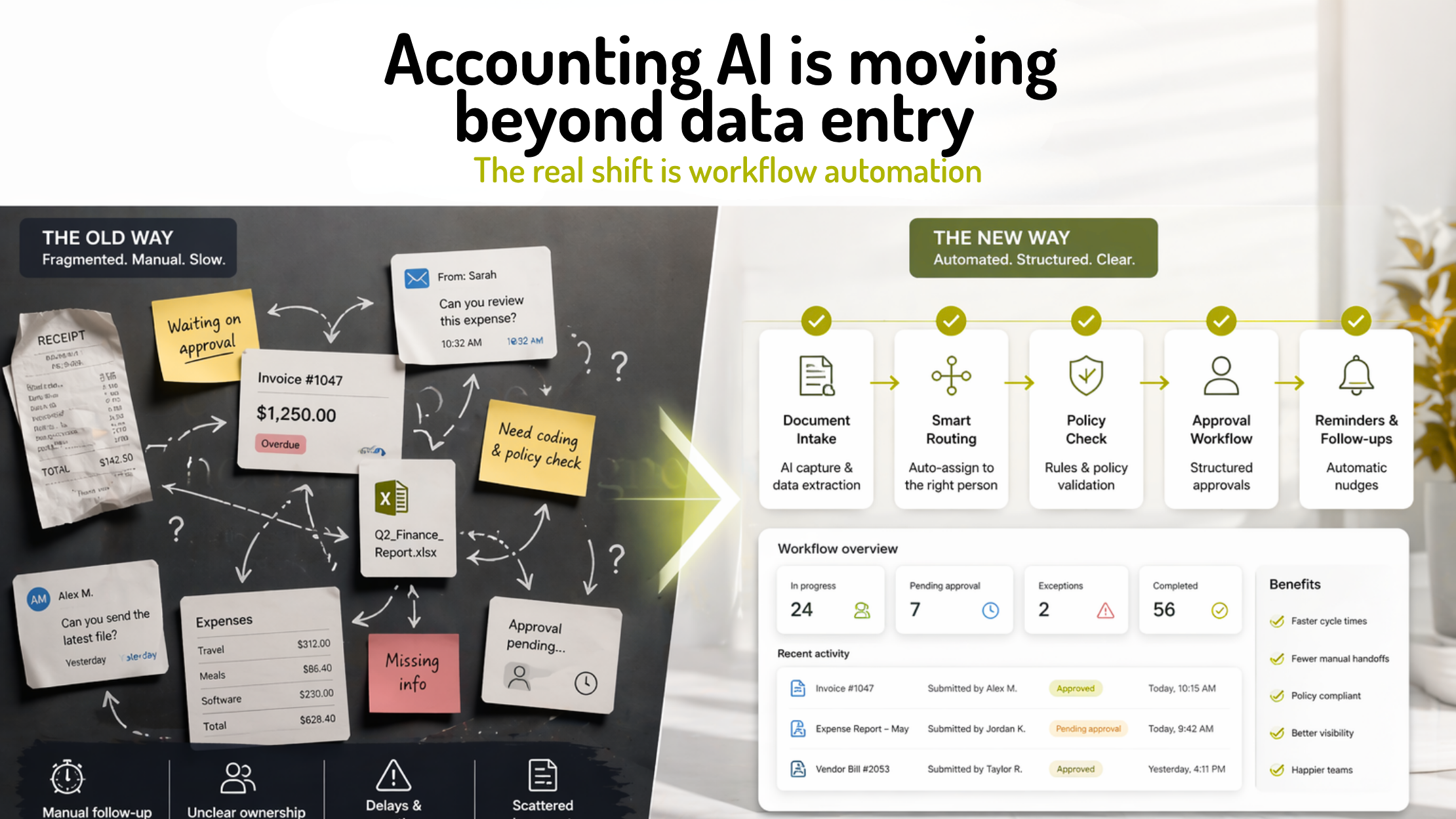
If you only follow the surface-level conversation, accounting AI still sounds like a speed story.
Faster data entry. Faster extraction. Faster categorization. Faster reporting support.
That is part of the picture. But it is no longer the most important part.
The bigger shift is that AI is moving deeper into how finance work actually flows.
That matters because most finance friction does not come from one task taking too long. It comes from the messy path around the task: missing inputs, delayed approvals, inconsistent formats, exception handling, and too much manual follow-up.
The real opportunity in accounting AI is no longer just:
How do we process this task faster?
It is:
How do we redesign the workflow around the task so work moves better, decisions happen faster, and fewer things fall through the cracks?
The market is moving past task speed
Early excitement around AI in finance focused on narrow efficiency gains.
Can we summarize reports faster?
Can we clean up messy inputs faster?
Can we draft a first pass more quickly?
Those gains are useful. But they are only the front layer.
What is becoming more interesting now is AI inside recurring finance processes: reviewing inputs, checking policy rules, routing items for approval, flagging exceptions, sending reminders, and helping work move through the business with less friction.
That is a different category of value.
Not just faster work.
Better flow.
The real problem is fragmented workflow
Many finance and accounting teams are not slowed down only by repetitive tasks.
They are slowed down by broken sequence.
That often looks like:
- documents arriving in different formats
- approvals living across inboxes and chat threads
- exceptions getting flagged too late
- reminders depending on people remembering to follow up
- reporting inputs arriving incomplete
- handoffs between finance and operations creating delays
- staff spending too much time chasing inputs instead of interpreting outputs
In that environment, AI used as a point tool can help a little.
But it will not solve the bigger issue.
Because the real friction is often not the task itself. It is the way the task moves through the organization.
A simple example
Take a common expense workflow.
An employee submits a receipt late.
The document is incomplete.
The manager approval sits in email.
Finance has to follow up manually.
The policy issue is only spotted near the end.
The reporting cycle gets delayed.
AI can help categorize the receipt faster.
But the bigger win comes when the workflow itself improves:
- intake is standardized
- required fields are checked earlier
- approvals are routed properly
- policy mismatches are flagged sooner
- reminders happen automatically
- exceptions are visible before they create delays
That is the difference between a faster task and a better process.
Finance teams do not need more AI theatre
This is where many companies will waste time.
They will test AI tools because the feature list looks impressive:
- extraction
- categorization
- summarization
- variance commentary
- chatbot support
- automated drafting
Useful, yes.
But if the surrounding workflow is still messy, the impact stays limited.
A company can add AI to accounting and still remain slow, inconsistent, and heavily dependent on manual coordination if:
- approvals are unclear
- responsibilities are fragmented
- exceptions are not routed properly
- source data is inconsistent
- teams are still working around the process instead of through it
That is why the more valuable question is no longer:
Which AI feature should we add?
It is:
Which finance workflows are still too manual, too approval-heavy, too fragmented, or too dependent on follow-up to scale properly?
That is where real automation value sits.
Where the real opportunity is
For many finance teams, the best AI opportunities are not in replacing judgment.
They are in reducing friction around structured, repeatable work.
That can include:
- expense submission and policy checking
- document intake and classification
- approval routing
- exception flagging
- reminder flows
- recurring summaries and reporting support
- reconciliation support
- internal finance requests
- handoffs between accounting, HR, procurement, and operations
These are not just AI tasks.
They are workflow tasks.
And that is why the shift matters.
Because once AI is applied to workflow design, the conversation changes from:
“We saved a few minutes here.”
to:
“We removed friction from a recurring process.”
That is a much stronger business outcome.
What to review first
For most SMEs and back-office teams, a useful first step is to review the finance workflows that create the most recurring friction.
Start with:
- expense approvals
- invoice or document intake
- exception handling
- reminder dependency
- reporting preparation
- cross-team handoffs
You do not need to automate everything.
You need to identify where structured automation can reduce delay, improve consistency, and free up time for higher-value work.
The next advantage will go to teams that redesign the flow
The finance teams that get the most value from AI over the next few years will probably not be the ones using the highest number of tools.
They will be the ones that:
- map where work gets stuck
- define clearer approvals
- standardize recurring inputs
- reduce exception chaos
- connect AI use to process outcomes, not tool novelty
That is where AI stops being a side experiment and starts becoming operating infrastructure.
And that is where the business case becomes easier to understand:
- fewer delays
- fewer missed steps
- better consistency
- stronger visibility
- lower coordination overhead
- more time for higher-value finance work
What companies should do now
A good next step is not to ask:
Which accounting AI tool should we try next?
A better question is:
Which finance and back-office workflows are still too manual, fragmented, or approval-heavy to support the level of speed and control the business now needs?
That is the right starting point.
Not a novelty.
Not feature shopping.
Operational clarity.
AUTHOR
Business Development Manager at LeLaboDigital, focused on connecting client challenges with practical digital solutions across web, automation, AI, SEO, and growth strategy.